I wanted to share another game that i've been following the development of for a while, it's called Crayon Physics Deluxe.
It is a physics base puzzle game developed by Petri Purho, an extension of the original Crayon Physics which was a freeware release on June the 1st 2007 and was inspired by the manifesto of the Experimental Gameplay Project...
1. Each game must be made in less than seven days, 2. Each game must be made by exactly one person, 3. Each game must be based around a common theme i.e. "gravity", "vegetation", "swarms", etc.
"The Experimental Gameplay Project is about discovering new forms of gameplay. Each game must be made in less than 7 days by 1 person, and show off something we've never seen before."
Crayon Physics Deluxe won the Seumas McNally Grand Prize at the Independent Games Festival in February 2008, and you can preorder a copy for $15 from the website http://www.crayonphysics.com/
I thought that this was quite an interesting game concept in terms of spatiality and the puzzle game. It is by SHUSHgame, so Barry Atkins, writter of More Than A Game: Computer Games as Fictional Form and Videogame, Player, Text (and blogger SHUSH!). It is a nice example with what can be developed as a simple flash game that plays with space.
I thought that it would be useful for you to know about this article by Rune Klevjer - Genre Blindness http://www.digra.org/hardcore/hc11 as it looks at Genre Studies in the field of Game Studies (or the lack there of) and is a call to arms to re-evaluate the usefulness of Genre Studies as a topology.
“… we need to take genre more seriously because we need to take the games themselves more seriously. We need to look for the significant difference before we settle for the well-formed generalisation. Genre blindness means game blindness.”
I am trying to organise a "field trip" to the Cave Automatic Virtual Environment (CAVE) at Salford's Peel Park Campus, the CAVE is part Salfords award winning research base "The Centre for Virtual Environments" (CVE). CVE houses one of the world's largest collections of apparatus for virtual environments.
I have contacted CVE and they have asked how many students will want to visit. The date of the visits will be 11th December... Salford is said to have the world's biggest CAVE and it is currently being rebuilt and refurbished.
Below is the trailer for the film "As Real as Your Life" which started as a freshman project by Michael Highland a self confessed game addict. His film brings some debates to light that we will be discussing further in H&A4, not around game addiction but around games as an augmentation, creating the cyborg body. I thought I'd give you the link as a teaser for some of the discussions that will follow next term.
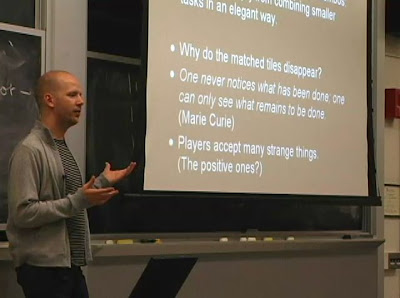
This weeks session focused on a video lecture by Jesper Juul given on 28/11/06 at MIT, a presentation of his research post Half Real.
What happens when a player picks up video game, learns to play it, masters it, and leaves it? Using concepts from my book on video games, Half-Real: Video Games between Real Rules and Fictional Worlds, I will argue that video game players are neither rational solvers of abstract problems, nor daydreamers in fictional worlds, but both of these things with shifting emphasis. The unique quality of video games is to be located in their intricate interplay of rules and fictions, which I will examine across genres, from casual games to massively multiplayer games.
The time is almost here for your marked student presentations, as your PA2 states…
This image is a link to a copy of your PA2
It has been students responsibilities to assign their own groups (of no more than 3) to present their arguments. As the PA2 states this is 40% of your 10 credits, so it is important that you all pose a coherent argument and prepare yourself for the questions and answers that will follow. Don’t forget that if you are arguing for one school of thought that there will probably be people in the audience that are there to argue the other so be prepared.
You can book suggested slots for your presentation here using doodle
I have tried to help you assign groups but it seems to be increasingly difficult week by week to keep track of your groups so… can people please add a list of group members to the comments of this post so I can try and keep track of them and try to help those not in groups to find people to work with.
Here is a link to a video debate on Game Studies hosted at HumLab between Henry Jenkins and Espen Aarseth which might be interesting for you to watch for your research…
It is important for us to understand that just calling a game by a tag word such as "RPG" or "shooter" is not enough to analyse a game and understand how it both fits within the matrix or taxonomy of genre and how genre works both as a category and a framework to understand games and their development. Genre is an important aspect of game analysis, many frameworks and methods of categorisation have been established throughout the development of game studies as a defined discipline, some are helpful in understanding the development of games and some are somewhat ludicrous!
Genre frameworks work both as an analytical tool and a marketing tool and it is important to understand what frameworks to use and what purposes they serve.
Apperley, T. H. Genre and Game Studies: Towards a critical approach to video game genres
http://sag.sagepub.com/cgi/content/abstract/37/1/6 (This will have to accessed from within the university firewalls on a student computer/athens login)
A player personality analyzer that classifies you as an explorer, socializer, killer or achieve. Originally designed for MUD (multi-user dungeon) participants, it remains relevant to new virtual worlds and MMORPGs. This is an updated version of the Bartle Test, the format and questions remain the same, the wording has just been updated to keep it relevant.
FPS Quiz (Multiplayer First Person Shooter Players)
Based on the format of the famous Bartle Test, this test applies to multiplayer FPS players, and classifies players as Recon, Shock Trooper, Support and Commander.