I thought that this was quite an interesting game concept in terms of spatiality and the puzzle game. It is by SHUSHgame, so Barry Atkins, writter of More Than A Game: Computer Games as Fictional Form and Videogame, Player, Text (and blogger SHUSH!). It is a nice example with what can be developed as a simple flash game that plays with space.
Showing posts with label CVG. Show all posts
Showing posts with label CVG. Show all posts
Wednesday, 19 November 2008


Seeing Genre
I thought that it would be useful for you to know about this article by Rune Klevjer - Genre Blindness http://www.digra.org/hardcore/hc11 as it looks at Genre Studies in the field of Game Studies (or the lack there of) and is a call to arms to re-evaluate the usefulness of Genre Studies as a topology.
“… we need to take genre more seriously because we need to take the games themselves more seriously. We need to look for the significant difference before we settle for the well-formed generalisation. Genre blindness means game blindness.”
“… we need to take genre more seriously because we need to take the games themselves more seriously. We need to look for the significant difference before we settle for the well-formed generalisation. Genre blindness means game blindness.”

Rune Klevjer's website has a list of his publications which might be useful to you http://folk.uib.no/smkrk/ and something that might be useful to people studying FPS' for their essay is his paper Way of The Gun: The aesthetic of the single-player First Person Shooter
Monday, 17 November 2008
CVE > CAVE
I am trying to organise a "field trip" to the Cave Automatic Virtual Environment (CAVE) at Salford's Peel Park Campus, the CAVE is part Salfords award winning research base "The Centre for Virtual Environments" (CVE). CVE houses one of the world's largest collections of apparatus for virtual environments.

I have contacted CVE and they have asked how many students will want to visit. The date of the visits will be 11th December... Salford is said to have the world's biggest CAVE and it is currently being rebuilt and refurbished.
Visit http://www.nicve.salford.ac.uk/facilities/ to view CVE's facilities.
Monday, 10 November 2008
As Real As Your Life
Below is the trailer for the film "As Real as Your Life" which started as a freshman project by Michael Highland a self confessed game addict. His film brings some debates to light that we will be discussing further in H&A4, not around game addiction but around games as an augmentation, creating the cyborg body. I thought I'd give you the link as a teaser for some of the discussions that will follow next term.
Highland, M. As Real As Your Life, 2009
http://uk.youtube.com/watch?v=Jr2p5eyjko0
Friday, 7 November 2008
Playing Research

This weeks reading is Espen Aarseth's - Playing Research:Methodological approaches to game analysis given at the MelbourneDAC, the 5th International Digital Arts and Culture Conference. May 19 - 23, 2003.
We will be doing quite a large feedback session on this text next week so make sure you read it, make notes and bring you discussions to class.
A Game In The Hands Of A Player
This weeks session focused on a video lecture by Jesper Juul given on 28/11/06 at MIT, a presentation of his research post Half Real.
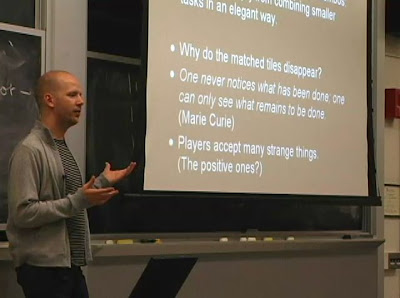
What happens when a player picks up video game, learns to play it, masters it, and leaves it? Using concepts from my book on video games, Half-Real: Video Games between Real Rules and Fictional Worlds, I will argue that video game players are neither rational solvers of abstract problems, nor daydreamers in fictional worlds, but both of these things with shifting emphasis. The unique quality of video games is to be located in their intricate interplay of rules and fictions, which I will examine across genres, from casual games to massively multiplayer games.
Tuesday, 4 November 2008
Understanding Genre
It is important for us to understand that just calling a game by a tag word such as "RPG" or "shooter" is not enough to analyse a game and understand how it both fits within the matrix or taxonomy of genre and how genre works both as a category and a framework to understand games and their development. Genre is an important aspect of game analysis, many frameworks and methods of categorisation have been established throughout the development of game studies as a defined discipline, some are helpful in understanding the development of games and some are somewhat ludicrous!
Genre frameworks work both as an analytical tool and a marketing tool and it is important to understand what frameworks to use and what purposes they serve.
Costikyan, G. 2005 Game Styles, Innovation, and New Audiences:An Historical ViewProceedings of DiGRA 2005 Conference: Changing Views - Worlds in Play
http://www.darkshire.net/jhkim/rpg/theory/styles.html
Apperley, T. H. Genre and Game Studies: Towards a critical approach to video game genres
http://sag.sagepub.com/cgi/content/abstract/37/1/6
(This will have to accessed from within the university firewalls on a student computer/athens login)
Sunday, 26 October 2008
What sort of player are you???
The Bartle Test
(MMORPG players)
A player personality analyzer that classifies you as an explorer, socializer, killer or achieve. Originally designed for MUD (multi-user dungeon) participants, it remains relevant to new virtual worlds and MMORPGs. This is an updated version of the Bartle Test, the format and questions remain the same, the wording has just been updated to keep it relevant.
FPS Quiz
(Multiplayer First Person Shooter Players)
Based on the format of the famous Bartle Test, this test applies to multiplayer FPS players, and classifies players as Recon, Shock Trooper, Support and Commander.
RTS Quiz
(Real Time Strategy Players)
Are you a Turtle, Strategist, Commander or Rusher?
Thursday, 23 October 2008
"I HAVE NO WORDS"
 This week’s reading is a two parter, but unlike a TV series, there is no “to be continued...” so if you wish to read the full text this week then feel free. The text is…
Costikyan, Greg "I Have No Words & I Must Design: Toward a Critical Vocabulary for Games" Computer Games and Digital Cultures Conference Proceedings, Tampere: Tampere University Press, June, 2002

(Greg Costikyans keynote speak from the 2002 Computer Games and Digital Cultures Conference all papers from the conference can be found here)
And we will be looking at the first section pages 9>26 (up to the “LEBLANC’S TAXONOMY” section). This text although long is a great read and shouldn’t be a struggle. We will be feeding back on our thoughts in the session so it is imperative that you read this text before the session.
For those that are keen on the term gameplay and want to read some more then this article is good - Attempting to Define Gameplay
Subscribe to:
Posts (Atom)


 Posts
Posts

